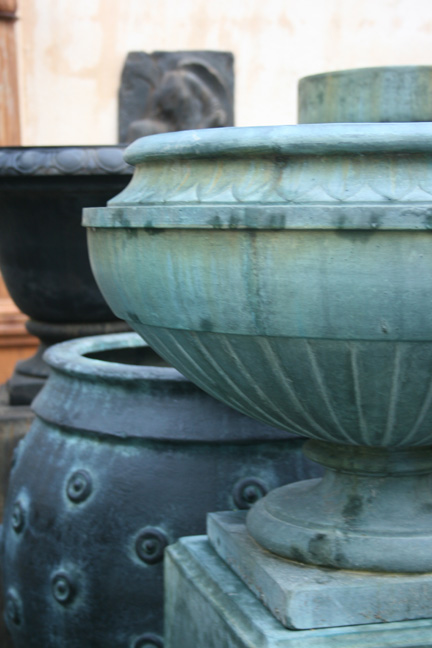
For decades, the decorative concrete industry used the word patina to describe what acid stains produce. The language was borrowed — from bronze foundry work, from aged stone, from the visual vocabulary of materials that had genuinely transformed through chemistry and time. But acid staining is not patination. It never was.
Understanding the difference is not a matter of preference or aesthetics. It is a matter of chemistry — specifically, of what happens to the surface at the moment of entry, and whether the color that results is a deposit or a transformation.
What Acid Stain
Actually Does to Cement
A conventional acid stain is an acidic solution — typically hydrochloric acid — carrying metallic salts in suspension. When applied to cement, the acid does not invite a reaction. It forces one by dissolving the alkaline matrix of the surface.
Cement's natural alkalinity — its calcium hydroxide content — is the very chemistry that makes reactive color possible. Acid stains consume it. The acid etches the surface, breaking down the calcium silicate hydrates and creating micro-porosity into which the metallic pigments deposit. The color that results is not grown from within the material. It is a residue, left in the damage the acid created.
Acid stains dissolve the very minerals that could have formed real, reactive color. In the rush for fast results, the surface chemistry that made patination possible was being destroyed to apply a substitute for it.
This is why acid stain results, while visually varied, tend toward a narrow tonal range — brown, amber, terracotta — and why they fade, mottle, and require sealing to survive. The color has no depth because it has no mineral structure beneath it. It sits in the damage, not in the material.
What the Gate Condition
Actually Requires
Law IV · The Gate Condition · SSD · Surface Saturated Dry
Reactive patination begins with a different question entirely. Not how do I force color onto this surface — but what is the surface telling me about its readiness to receive?
The Law of Entry states that only what enters will react. Entry is not forced — it is invited, through the precise management of surface moisture state. The surface must be at SSD — Surface Saturated Dry — the condition in which the capillary network is primed to receive without being flooded.
At SSD, the surface is neither bone dry nor visibly wet. It is in a precise intermediate state — the Gate Condition — in which moisture fills the pore structure to capacity without standing water on the surface. At this threshold, reactive solutions can travel inward through the capillary network, carried by the moisture gradient rather than fighting against it.
The Gate Condition is not a trick. It is the surface declaring its readiness. Miss it in either direction and entry fails — the solution either flashes on a dry surface or runs on a wet one, never blooming.
How Reactive Color
Actually Forms
Law of Travel · Ionic Front Separation · The Escort Ion
Once a reactive solution enters at the Gate Condition, the Laws of Travel govern what happens next. The solution — a metallic salt in an aqueous carrier — moves through the capillary network as a system, not as a single substance. The water and the ions travel together, but not at the same speed.
The Law of the Escort Ion states that no ion travels alone. Every metal salt carries a partner ion — the counter-ion — that determines its speed at the gate and its behavior in the field. Copper nitrate and copper sulfate behave differently not because of the copper, but because of what the copper is riding with. Nitrate has low hydration drag and high mobility. Sulfate has high hydration load and moves more slowly. The escort determines the journey.
As the solution moves through the surface, the metal ions encounter the alkaline chemistry of the cement — the calcium hydroxide that acid staining destroys. Here, instead of being deposited into etched damage, the metal ions react with the alkaline field. Copper forms malachite and atacamite — genuine mineral compounds. Iron forms goethite and hematite. Manganese forms birnessite. These are not pigments. They are minerals grown in place, bonded into the crystal structure of the cement itself.
The Comparison
In Plain Terms
| Question | Acid Stain | Reactive Patina |
|---|---|---|
| What does it do to the surface? | Corrodes the alkaline matrix | Enters and reacts with the alkaline matrix |
| What is the color? | Pigment deposited in acid damage | Mineral compounds grown in place |
| Where does color live? | In the etched surface layer | Within the capillary structure at depth |
| What controls the outcome? | Product concentration and dwell time | Surface state, moisture, pH, timing, and escort ion |
| Is it permanent? | Requires sealing to survive | Bonded into the mineral structure of the surface |
| What does alkalinity mean? | An obstacle to be neutralized | The invitation that makes reactive color possible |
Why This Matters
Beyond Technique
The distinction between acid staining and reactive patination is not a debate between two competing products. It is a difference in fundamental orientation — toward the material, toward the surface, toward the chemistry that both methods engage with.
Acid staining treats alkalinity as a problem. Reactive patination treats it as a collaborator. One approach destroys the surface chemistry in order to apply color to the damage. The other reads the surface chemistry and works within it, using the same mechanisms that produce the world's most durable mineral colors — the iron reds of the Australian outback, the copper greens of ancient bronze, the manganese blacks of the earliest cave art.
These colors have survived because they are not applied to a surface. They are the surface — transformed, not coated. That is precisely what reactive patination achieves when the Laws of Entry and Travel are understood and respected.
The art was already in the material. The only question was whether to destroy that chemistry for a quick result, or to work with it for a result that lasts.