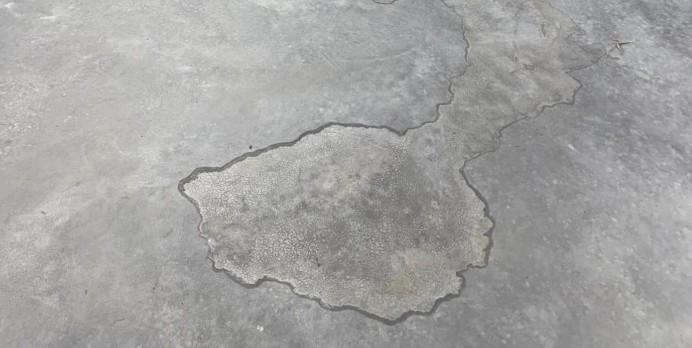
Every contractor, every homeowner, every studio practitioner has encountered it. A wet slab dries unevenly. A puddle sits too long. Rain crosses a threshold. And when the moisture clears, a ghost remains — a pale ring, a dark tide line, a boundary that no amount of scrubbing will remove.
The instinct is to scrub harder. To use a stronger cleaner. To assume the surface is dirty. It isn't. What you are looking at is not contamination. It is chemistry — specifically, a process the Laws of Travel describe as Threshold Precipitation at the Moisture Front.
What Actually Happens
When Water Moves Through Cement
Cement is not a passive material. It is a reactive mineral field — a landscape of calcium silicates, hydroxides, and soluble salts that respond to moisture by moving. When water enters a cementitious surface, it does not simply wet the material. It becomes a carrier, transporting dissolved ions through the capillary network of the substrate.
Only what can move can color. And what moves is not just water — it is the mineral payload that water carries with it. Calcium. Iron. Manganese. Soluble salts of every kind. All of them ride the moisture front outward, carried by capillary action toward the drying edge of the wet field.
The moisture front is not just a boundary. It is a travelling chemical environment — one that can only exist in motion.
As long as the surface remains uniformly wet, this migration is invisible. The ions are distributed throughout the field. Nothing precipitates. Nothing marks. But as the moisture front advances toward the dry edge — the boundary where wet meets dry — something critical happens.
The Arrest Line —
Where Chemistry Stops Moving
Threshold Precipitation · The Arrest Line · Law of Travel
At the outer edge of the moisture front, evaporation is fastest. The moisture film becomes thinnest. And as it thins, the dissolved mineral load that the water has been carrying can no longer remain in solution.
The ions precipitate. Not because they were added to the surface — but because the conditions that kept them mobile have been withdrawn. The water evaporates. The salts concentrate. And at the exact line where the moisture front stalled and retreated, those salts deposit permanently into the pore structure of the cement.
This is the Arrest Line. The precise boundary where travel ended and transformation began. It is not a coating on the surface. It is a mineral deposit within the surface — bonded through the same chemistry that gives reactive patinas their permanence.
You cannot scrub out a watermark because the mark is not on the cement. It is in the cement — precipitated into the pore structure at the point where moisture stopped.
Why Wetting the Field
Dissolves the Contrast
Field Equalization · Re-Entry · Law II
Here is the observation that confirms the mechanism — one every experienced practitioner has noticed without necessarily understanding why.
When you wet the concrete field surrounding a watermark, the mark appears to disappear. The contrast boundary dissolves. The ring becomes invisible. The moment the field dries again, it returns.
This is Field Equalization — the direct expression of Law II of the Laws of Travel: Dilution restores the gate. When the surrounding field is re-wetted, the moisture gradient that created the contrast boundary is temporarily eliminated. The dry surrounding field — which appeared lighter — is now at the same moisture state as the arrested zone. The visual difference disappears because the physical difference has been temporarily neutralized.
When the field dries again, the gradient re-establishes. The Arrest Line becomes visible once more — not because new chemistry has occurred, but because the moisture contrast that makes it legible has been restored.
Why Scrubbing
Cannot Reach It
Scrubbing acts on the surface. It removes loose particles, contamination, and surface deposits. But the Arrest Line is not a surface deposit. It is a sub-surface mineral transformation — ions that have precipitated into the capillary structure of the cement itself, bonded at depth.
To remove a watermark by abrasion, you would need to remove the cement that contains it. Grinding works — but it removes the surface. Acid treatment can dissolve some precipitates — but it also attacks the cement matrix and leaves its own record. There is no cleaning method that selectively removes sub-surface mineral precipitation without affecting the surrounding material.
The only permanent resolution is Field Equalization at the surface level — achieved either by treating the entire surface to create a uniform reactive field, or by introducing a reactive patina that transforms the entire surface chemistry rather than attempting to remove what has already been deposited.
What This Reveals
About Reactive Surfaces
The watermark is not a flaw. It is the most honest record a cement surface can produce — a precise map of where moisture travelled, how far it went, and where it stopped. In the language of the Laws of Travel, it is a field record of arrested motion.
Reactive Patinas™ works with this same mechanism — deliberately, precisely, and with full understanding of the chemistry involved. Every reactive color that enters a cement surface follows the same laws as the watermark. It travels with moisture. It concentrates at boundaries. It precipitates into the pore structure and becomes part of the permanent mineral record of the surface.
The difference between a watermark and a reactive patina is intention. One is accidental. The other is a conversation — conducted in the language the surface already speaks.