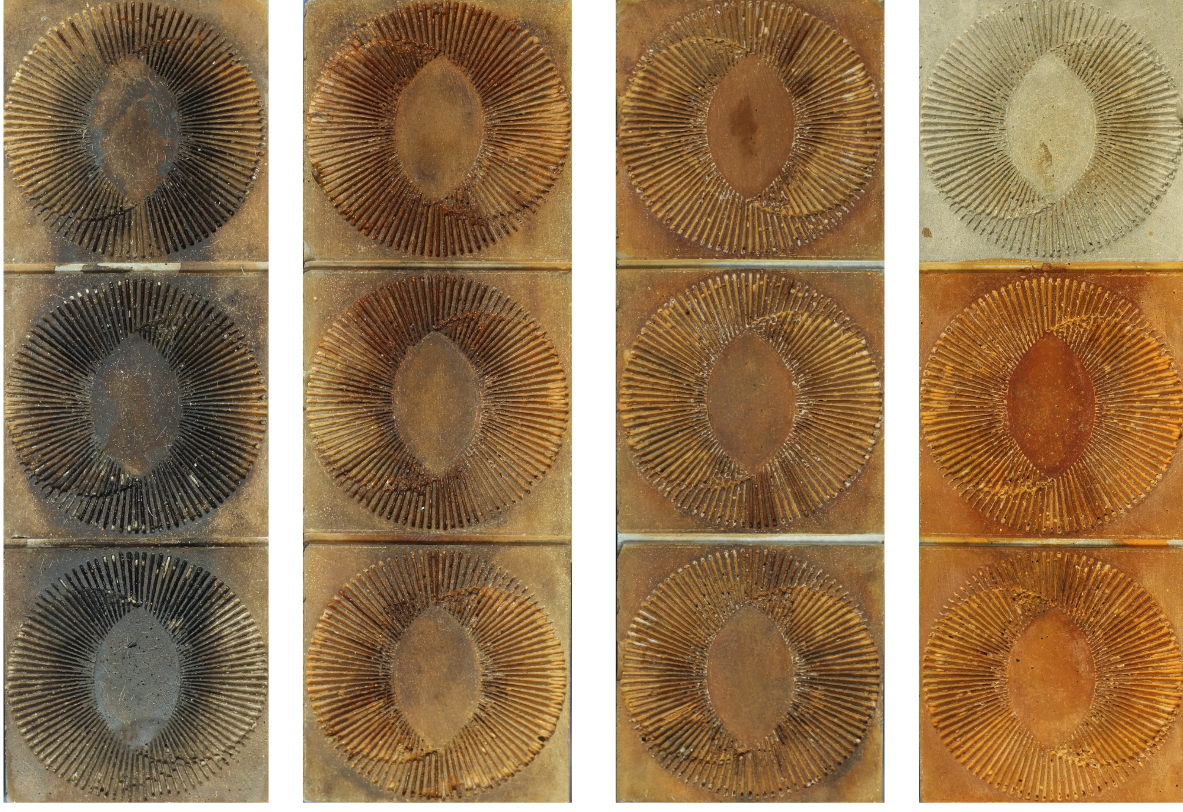
 FS⇄MS Decile Ladder · Triplex Plates 29–34 · Oz¹ 3% H₂O₂
FS⇄MS Decile Ladder · Triplex Plates 29–34 · Oz¹ 3% H₂O₂
FS⇄MS Decile Ladder · Triplex Plates 29–34 · Oz¹ 3% H₂O₂
When FS⇄MS blends are applied to triplex swatches, the central oval goes umber while the channels arrest in amber rust. This is not a colour choice. It is not an anomaly. It is a curing record — encoded directly into the reactive surface by geometry.
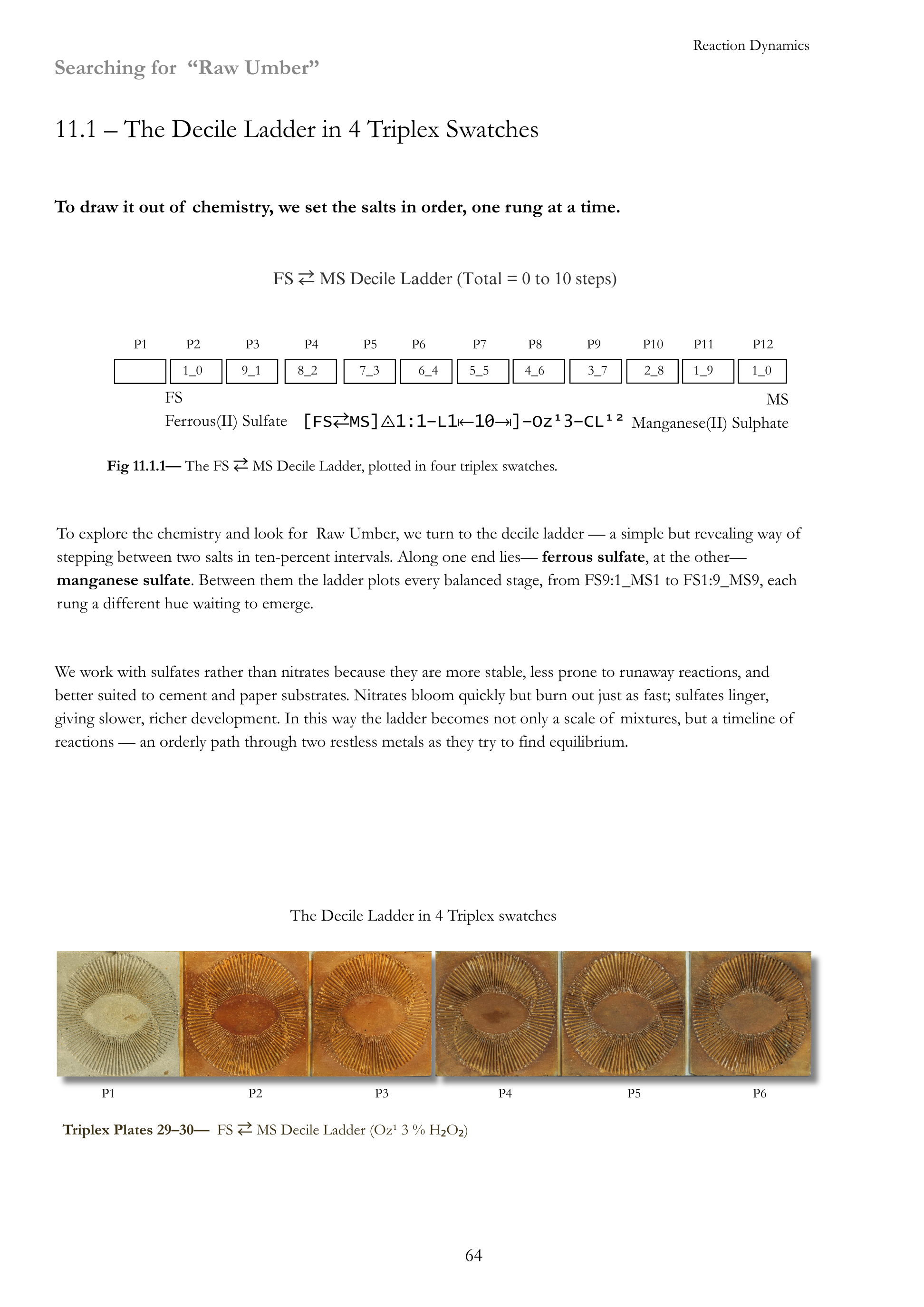
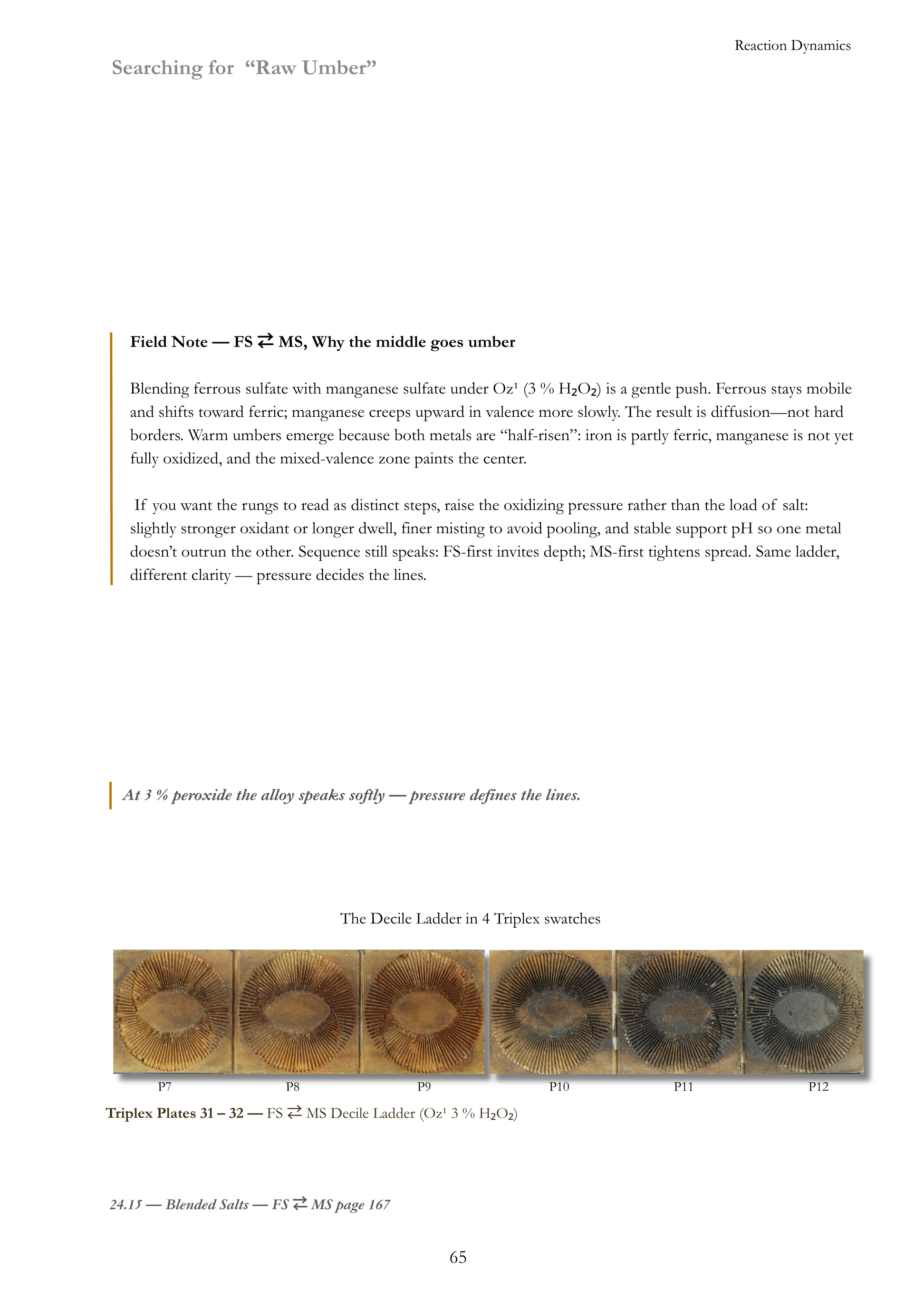
The triplex swatch is a radial pattern — nails or rods arranged in a sunburst around a central oval void. When a reactive solution is applied, this geometry does not simply shape the aesthetic result. It creates three simultaneously distinct hydration zones on a single tile, each arresting at a different chemical moment.
The geometry is not decoration. It is chemistry control — a spatial modifier of the Gate Condition operating simultaneously across a single surface.
| Zone | Geometry | Hydration behaviour | Reactive record |
|---|---|---|---|
| Radial Channels | Deep, directional, high surface area | Fastest evaporation — earliest arrest | Initial oxidation state locks in first — amber rust in FS-dominant rungs |
| The Central Oval | Sheltered by radiating nail mass | Slowest evaporation — longest chemical openness | Both metals continue developing after channels arrest — the mixed-valence zone produces umber |
| The Boundary Ring | Transition between channel and oval | Threshold Precipitation at the geometry edge | The Arrest Line expressed through form — dark intensification at the reservoir boundary |
The Field Note from the book states it precisely: warm umbers emerge because both metals are "half-risen" — iron is partly ferric, manganese is not yet fully oxidized, and the mixed-valence zone paints the center.
The central oval is a Hydration Reservoir — a zone that retains moisture beyond the surrounding field because it is sheltered from edge evaporation by the geometry itself. In this reservoir, the reactive system stays open longer. The metals have more time to travel, more time to approach equilibrium. Neither reaches full oxidation. Both remain in transition. And that transitional chemistry — iron partly ferric, manganese not yet birnessite — produces the warm, complex umber that neither metal produces alone.
The umber is not a mixture of two colours. It is a record of two simultaneous incomplete reactions — preserved at the moment the reservoir finally dried.
The dark intensification ring at the boundary between the central oval and the radial channels is the same mechanism as the concrete watermark — Threshold Precipitation at the Moisture Front. In the watermark, the boundary is defined by an accidental pooling event. In the triplex swatch, the boundary is defined by the geometry of the mould.
One is accidental. The other is designed. Both are governed by the same law: as the moisture front retreats, the dissolved mineral load concentrates and precipitates at the exact line where travel stopped. The difference is that here, the geometry tells the moisture front precisely where to stop.
If you want the rungs of the decile ladder to read as distinct, separated steps rather than a diffused gradient — raise the oxidizing pressure rather than the salt load. A slightly stronger oxidant, a longer dwell, finer misting to avoid pooling, and a stable support pH so neither metal outruns the other.
Sequence speaks too. FS-first invites depth — iron enters and primes the alkaline field before manganese arrives. MS-first tightens the spread — manganese claims the surface early, limiting how far iron can travel. Same ladder, different clarity.
At 3% peroxide the alloy speaks softly — pressure defines the lines.