Twenty years in bronze.
Dave Mune founded his first art foundry in New Zealand at twenty years old. For the next two decades, bronze was the material — casting, finishing, patinating. Working directly with metal at the scale of sculpture and architectural form.
In a foundry, patination is not decoration. It is chemistry. Iron salts, copper salts, acids, heat, moisture — reactive systems that transform a metal surface from within. The practitioner either understands what is happening or they don't. Dave Mune understood. And he began asking questions that the field had not formalised answers to.
In the foundry, you learn quickly that the surface is not passive. It decides what it will accept, when it will accept it, and how far it will carry it.
Twenty years in cement.
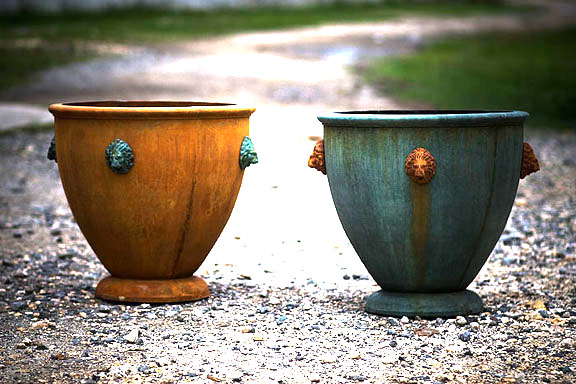
The move from bronze to decorative cement was not a departure — it was a recognition. The same reactive chemistry that governs metal patination governs mineral surfaces. Cement is alkaline, porous, and chemically active. When iron salts enter a cement surface under the right conditions, the reaction is not cosmetic. It is structural. The color enters the body of the material and becomes permanent.
For twenty years Dave Mune worked in decorative concrete — designing, manufacturing, and installing pieces across Australia, Southeast Asia, and the Americas. Much of the production was manufactured in Asia, where the scale and complexity of the work demanded complete command of material behavior across different climates, substrates, and field conditions.
It was during this period that the Laws of Entry and Travel began to take shape — not as a theoretical framework, but as field observations repeated across thousands of surfaces until the patterns became undeniable. These are not theories. They are field truths.
The first complete language for a field.
The science of reactive color on mineral surfaces existed in fragments — scattered across electrochemistry, soil science, surface physics, materials engineering, and the unpublished knowledge of individual practitioners. No single body of work had brought it together, named its laws, and made it teachable.
The Reactive Patinas™ series — four volumes covering cement, gypsum, laminated fiber cement, and reactive paper — is that body of work. Written not from an academic position but from forty years of direct encounter with reactive surfaces, it documents what actually happens when chemistry meets mineral: how ions enter, how they travel, when they arrest, and why the results are permanent.
Every failure was a lesson. Every lesson changed the work. The journey till today has not ended — and that is exactly as it should be.
The Laws of Entry. The Laws of Travel. The Doctrine of the Closed Gate. The Law of the Escort Ion. These are not inventions — they were always there, in the behavior of every surface Dave Mune ever worked with. The books gave them names.
A shared language, growing.
The Reactive Patinas™ system is now used by artists, architects, makers, educators, and material thinkers internationally. The RSE program — Reactive Surface Experiments — brings the same chemistry to paper, making it accessible to students and classrooms without specialist equipment.
The Community Field exists because this knowledge should not remain in the hands of one person. Every practitioner who enters the field, observes carefully, and shares what they find adds to the record. The language grows. The field grows with it.
Dave Mune continues to work, document, and teach from his base in the field — wherever the next surface presents itself.