
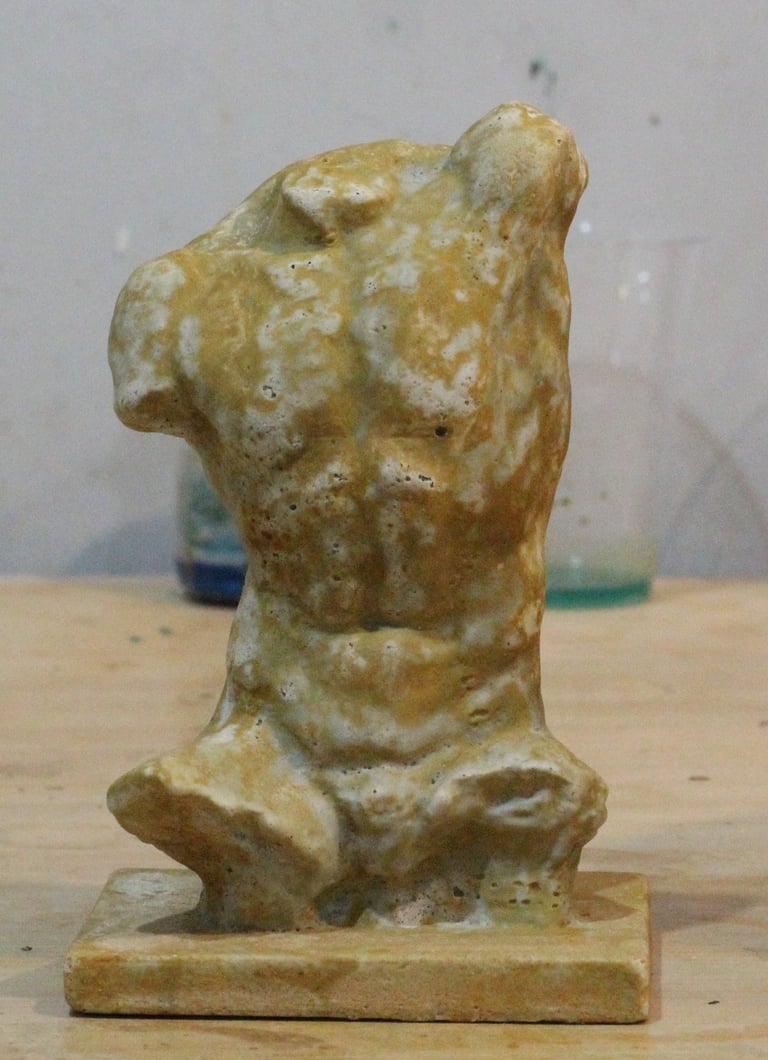
Why It Failed: Uneven Gates from Improper Lime Blending
Failure Type: Delayed surface failure
Root Cause: Inadequate pre-blending of lime
Trigger Event: Silicate soaking
At first glance, this piece appears to have failed during coloring or sealing. In reality, the failure occurred much earlier — during mixing — and remained latent until it was revealed by silicate treatment.
The lime (Ca(OH)₂) was not dry pre-blended into the gypsum. Instead, the plaster was hand-mixed briefly before casting. This produced a heterogeneous body with localized zones of high and low alkalinity. At casting and early cure, the gypsum set normally and showed no visible defects.
The failure emerged only during silicate soaking.
High-lime regions reacted aggressively with the silicate, rapidly densifying and closing the pore field. Low-lime regions densified more slowly and remained open. This created an uneven gate condition across the surface. Subsequent reactive salts could enter some areas freely while being excluded from others, producing the mottled, irregular surface seen here.
What appears to be staining inconsistency is, in fact, a map of lime concentration, revealed by silicate.
Key Lesson
Silicate does not create defects — it exposes them.
Uniform reactivity requires uniform permission. Lime must be thoroughly dry pre-blended and mixed mechanically (battery drill, not a stick) to ensure an even alkaline field. Without this, the surface becomes a patchwork of gates that will never behave consistently, no matter how carefully later steps are executed.
Prevention
Always dry pre-blend lime into gypsum
Use mechanical mixing (battery drill + paddle)
Avoid short hand-mixing for reactive work
Assume silicate will reveal, not forgive